
Eiders of Coquet Island
Eider ducks, locally known as Cuddy ducks, have been closely associated with Northumberland since the era of St Cuthbert in the 7th century. They remain a significant presence in the region.
Eiders are the largest and heaviest ducks in the Northern Hemisphere, and more surprisingly, they are also the fastest flyers, with documented speeds of up to 70 mph in level flight.
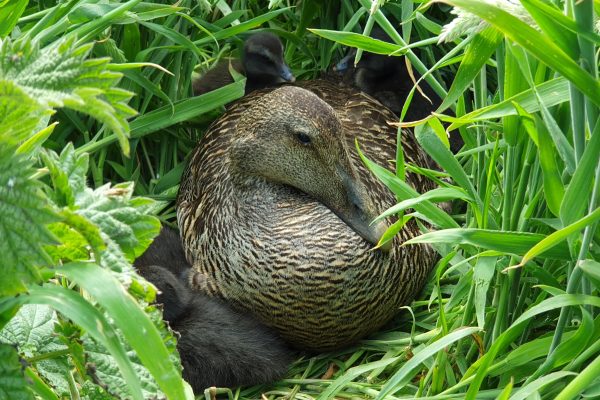
Normally, however, you will most commonly see them feeding around the shoreline or in Amble harbour. Male eiders display striking black and white plumage during the winter and early summer months. They moult in late summer. The females are a beautiful speckled brown, a useful adaptation that helps provide camouflage when nesting.
Their diet mainly consists of shellfish, which they swallow whole. Although their favourite food is considered to be mussels, which they dive down to take off the rocks.
During the spring the males make their iconic a-woo call as they search for a mate. This year, our first nest was discovered on the island on 15 April, and since that time more have appeared.
Currently, at the time of writing, on Coquet Island we are about to undertake our first Eider census of the season. This involves us walking the entire island, including the shoreline. This typically takes us the whole day to complete. Following this, we will undertake a second Eider census 25 days later, focusing solely on counting birds on nests. Last year, in 2025, we recorded 333 nests, which was the highest count since 2018.
The average number of eggs that an eider will lay in a clutch is between four to six. We have observed clutches containing up to nine eggs, which is likely the result of egg dumping; this is when another female lays her egg in the same nest. This can happen easily, as the females won’t sit on their nests until they have a full clutch.
Once the eggs hatch, the females leave their breeding sites quickly, usually within two days, and head back to the mainland with their ducklings in tow. With ducklings the size of a small fist, the journey to the safety of the harbour is no easy feat.
Females often group into creches to help look after the young, or non-breeding females may join as ‘aunties’ to help watch out for the young. You may see examples of their protective nature as they lunge at aerial predators or chase after other ducks.
The population trend of Eiders cannot be measured by the number of nests each year, as they are a species where there may be years when females decide not to breed, along with the fact that females will often share nests and there is still much that we don’t know about how Eider ducks use this area.
You can help us. As we move into summer, we are on the lookout for reports of Eiders along the Northumberland coast, whether adult ducks, duckling creches, or disturbances happening around them. Anyone can become a citizen scientist by recording their Eider sightings into the Eider Aware Survey 123 mobile app, which will help us monitor the populations of Northumberland’s Eiders more closely.
For more information about this project and other ways to report Eider sightings, the Eider Aware North East page can be found on the Berwickshire and Northumberland Marine Nature Partnership website.
Rebekah Goodwill
RSPB Coquet Island Warden