How to help save a life
Would you know what to do if someone collapsed in front of you? A training session on CPR was recently held at the Radcliffe Club and I went along to find out more.
Dougie McEwan from the Stephen Carey Fund, took us through how the charity came into being. In 2012 Stephen Carey collapsed on a football pitch in Warkworth and despite attempts by responders he passed away aged 21. Over the following 12 months money was raised to provide first aid kits and the Stephen Carey Fund was registered as charity in 2013. All those working for the Fund are volunteers and pay for their own expenses, wherever they are going. The Fund has installed over 190 public access defibrillators throughout Northumberland and numerous lives have been saved.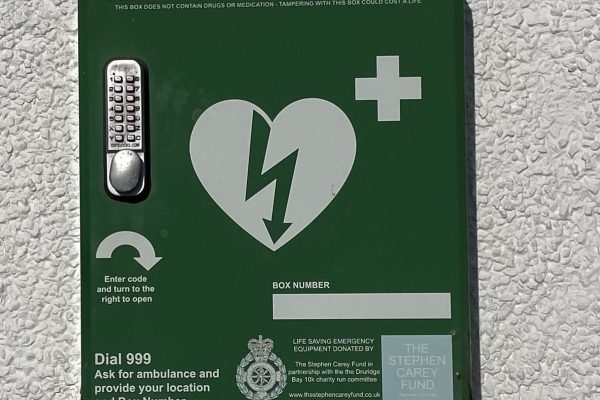
The first part of the evening concentrated on Heart Attack, Angina and Cardiac Arrest. Dougie spoke about symptoms and the differences between them.
Using mannequins, he described the following action plan:
D (Danger) ensuring the area is safe for the responder, the casualty and others.
R (Response) how to check for a response from the casualty.
S (Shout) how to call for help.
A (Airway) open the airway by tilting the head back and lifting the chin.
B (Breathing) how to check if the casualty is breathing and when to call 999/112 immediately and begin CPR.
C (CPR) chest compression cycles and rates of compressions
He demonstrated how to use CPR on a child and the technique for placing the casualty in the recovery position and the differences for a child and a pregnant woman.
Dougie then moved on to defibrillators; how to open one and how it worked. The defibrillator talks the user through the process up to the point of ‘shock delivered’. He explained that each defibrillator has a guardian who has the responsibility of checking the machine on a weekly basis. Using the DefibFinder app will locate defibrillators in the local area.
The evening finished with a demonstration on how to assist someone who is choking. Dougie made the event thoroughly enjoyable and taught us techniques to save a life.
A conversation with a good friend made me realise how we never know when techniques like this will be needed.
Catherine Atkinson used to be a specialist resuscitation nurse at the RVI in the 1960s. She told me how very recently her 81-year-old husband had a sudden cardiac arrest. She said:
“Seconds after my husband collapsed, I phoned 999 while at the same time starting cardiac massage. His heart and breathing had stopped. I gave him a big hard thump at the bottom part of his sternum and then started the regular rhythm of cardiac massage as hard as I could physically manage and never stopping. As I was on my own, it was important to concentrate on the cardiac massage to try and keep some blood circulating around his heart until help arrived.
“After about four minutes my husband suddenly took a gasp. This coincided with the paramedics arriving at the door. Having brought him round, I was so relieved to hand over to the medics as at this point, I was in a complete state of exhausted shock.
“My husband was taken to the Freeman Hospital Coronary Care Unit in Newcastle. It was established that he had a clot in his right coronary artery. He has now made a full recovery, which, in part, is due to his good general fitness.
“I want to thank the 999 operator, the paramedics and the Freeman Hospital, all of whom were brilliant, professional and so supportive. Immediate cardiac massage was the most important thing in saving my husband’s life.”
Ray Wilcox